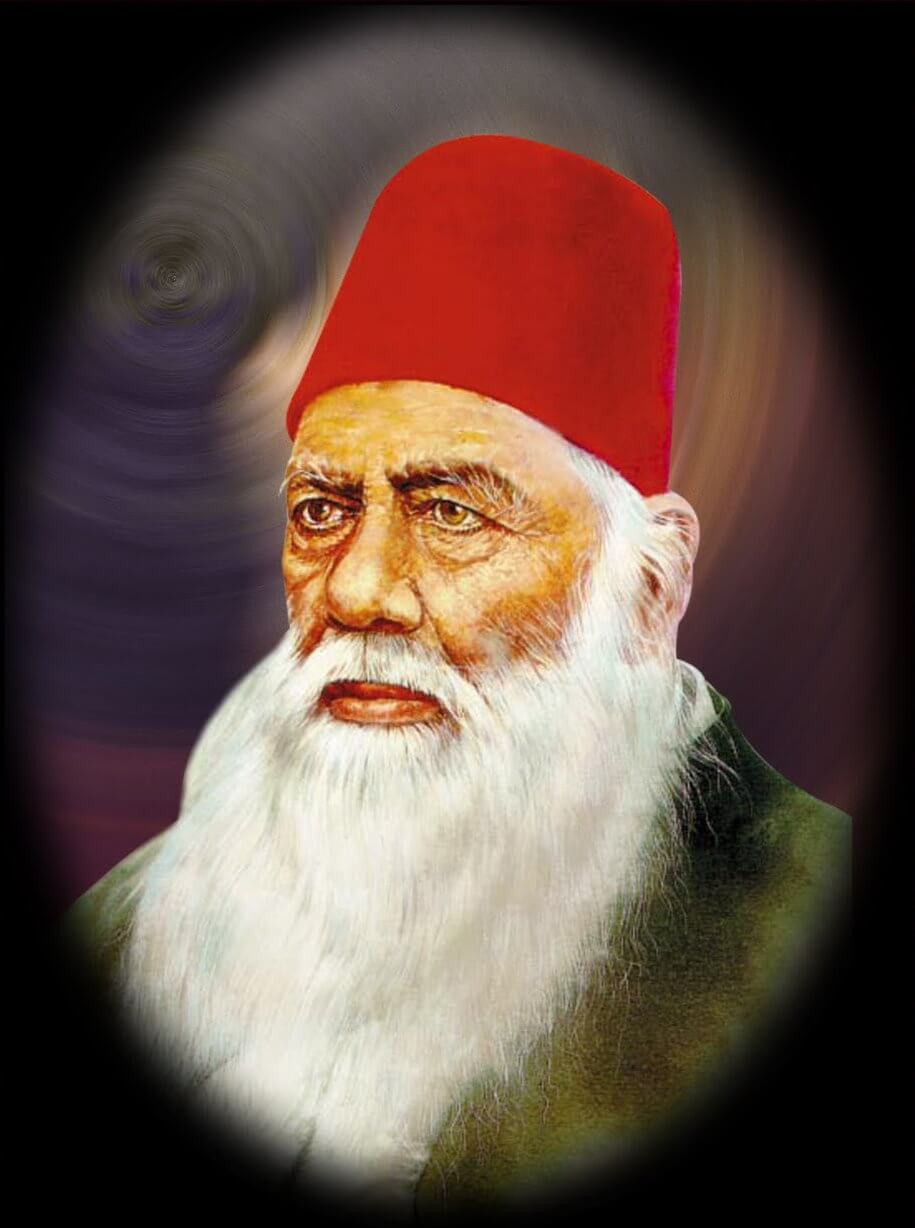
Born on October 17, 1817. His lineage reaches the Prophet Muhammad (PBUH) through 36 generations. His father was Mir Muttaqi and his mother was Aziz al-Nisa Begum.
At the age of four, his Bismillah ceremony was held. He studied Arabic, Persian, Mathematics, and Geometry. At 18, he finished the first phase of his formal education.
Against family tradition, he joined the East India Company. He served as a Munsif (Judge) and was later bestowed the title of Jawwad-ud-Daula Arif Jung by Emperor Bahadur Shah. He retired in 1876.
During the Mutiny, when Bijnor was a rebel centre, Sir Syed remained loyal to the British and saved many English lives. This event deeply impacted him and shaped his mission for the Muslim community.
He was made a Knight Commander of the Star of India, appointed to the Governor General's Council, made an honorary Fellow of the Royal Asiatic Society (1864), and received an honorary doctorate from the University of Edinburgh (1889).
1857 was a turning point in the history of India. The suppression of the Movement of 1857 brought great sufferings for all sections of the Indian society, but it was a total catastrophe for the Muslims. Their lands and properties were confiscated. The entire community had become the object of suspicion and hatred.
Sir Syed reached the conclusion that the only alternative was to work for the betterment of the Muslim society under British dispensation. He diagnosed the maladies and suggested the cure on the following lines:
For the next 40 years of his life, Sir Syed worked tirelessly on these lines. His mission for the regeneration and rejuvenation of Muslim society came to be known as the Aligarh Movement.
Established at Ghazipur on 9 January, 1863 and shifted to Aligarh in 1864. Sir Syed believed the best education is imparted in the mother tongue. By 1875, the Society had translated and published 27 standard works from English into Urdu, including Elphinstone's History of India and Darwin's works.
An attached school was established on 24th May, 1875. On 8 January, 1877, the foundation stone of the college was laid by Lord Edward Robert Lytton. Classes began on 1st January, 1878. By 1882, the B.A. result was as high as 80 percent. The college promised to become a "Muslim Oxford".
Set up at Aligarh to discuss the educational backwardness of Muslims. During the secretaryship of Nawab Mohsinul Mulk, sessions were held across Lahore, Calcutta, Chennai, Mumbai, Dhaka, and Rangoon. In 1910, it passed a resolution to establish a Muslim University.
Born in 1837 in Etawah. He topped the Provincial Civil Service examination in 1867. A man of broad views, a born orator, and a strong advocate of Hindu-Muslim unity.
Born in 1841 in Meerut. One of the most eminent figures behind the Aligarh Movement after Sir Syed. He spearheaded intense efforts to set up the Muslim University.
Born in 1832 at Moradabad. Sir Syed praised his sincerity and nominated him as Co-President of The Society for life. He played a key role in communal harmony.
Born in 1844 in Meerut. He contributed numerous works to the school of Muslim Modernists such as "A Critical Exposition of the Popular Jihad".
Born in 1837 in Panipat. He composed the epic poem Musaddas e-Madd o-Jazr e-Islam. After Sir Syed's death, Hali wrote his biography Hayat-e-Javed.
Born in 1834 at Delhi. In 1857, he saved his and Sir Syed's family from the English forces. He was the founding secretary of Madrasatul Uloom.
Born in 1831 in Bijnor. An ardent supporter of Sir Syed. His notable works are Binat-un-Nash, Taubat-un-Nashuh, and Mirat-ul-Uroo.
Born in 1857 in Azamgarh. He joined MAO College in 1882 and taught Persian and Arabic for sixteen years.
.jpeg)
Aligarh Muslim University (AMU) occupies a unique position amongst universities and institutions of higher learning in the country. It was established in 1920 and evolved out of the Mohammedan Anglo-Oriental (MAO) which was set up on 8 January 1877 by the great visionary and social reformer, Sir Syed Ahmad khan. From its very inception, it has kept its door open to the members of all communities and from all corners of the country and the world. The Aligarh Muslim University is the realization of a vision which was broad, far-reaching and realistic.
Spread over 467.6 hectares in the city of Aligarh, Uttar Pradesh, Aligarh Muslim University offers more than 300 courses in the traditional and modern branches of education. It draws students from all states in India and from different countries, especially Africa, West Asia and Southeast Asia. In some courses, seats are reserved for students from SAARC and Commonwealth Countries. The University is open to all irrespective of caste, creed, religion or gender. It ranks 8th among the top 20 research universities in India.
In spite of the establishment of a number of universities and institutions of higher learning all over the country, this University has been maintaining its national and international character as an institution of excellence. It has more than 37327 students, 1,686 teachers and some 5,610 non-teaching staff on its rolls. The University now has 13 faculties comprising 117 teaching departments, 3 academies and 21 centres and institutes. A special feature of the University is its residential character with most of the staff and students residing on the campus. There are 19 halls of residence for students with 80 hostels.
Apart from the conventional Undergraduate and Postgraduate courses in Social Sciences, Sciences and Humanities, the University keeps pace with the nation's growth by offering facilities for specialized learning in areas of technical, vocational and interdisciplinary studies. It has the Zakir Hussain College of Engineering and Technology, Jawaharlal Nehru Medical College, Dr. Ziauddin Dental College, Institute of Ophthalmology, Food Craft Institute, Interdisciplinary Biotechnology Unit, Centre of Advanced Study in History, Department of West Asian Studies, Centre of Wildlife, Centre for South African & Brazilian Studies, Department of Islamic Studies, Academic Staff College, Women's College, Ajmal Khan Tibbiya College, Polytechnics separately for boys and girls and Computer Centre etc.
On 24 May 1875, Sir Syed founded the Madarsatul Uloom in Aligarh and patterned the MAO after Oxford and Cambridge universities that he went on a trip to London. His objective was to build a University in line with the British education system but without compromising its Islamic values.
The University has opened three new centres of study outside Aligarh at Murshidabad, West Bengal state, at Mallapurum, Kerala state and at Kishanganj, Bihar State.
The University maintains one primary, seven High schools (including one for the Visually Challenged), and two Senior Secondary schools for boys and girls. The University also offers courses in Indian, Oriental and Western Languages. The medium of instruction in the University is primarily English.
Games and sports have been a distinctive feature of the AMU. The Skating and Riding teams have excelled at the inter-University level. Perhaps this is the only University with a Riding Club.
The General Education centre is the nucleus of most of the extra-curricular activities and caters to the cultural environment. This centre organizes these activities through its various clubs viz., the AMU Literary Club, the Hindustani and western Club, the Literary Club and the Hobbies Workshop etc.
It is proudly Islamic and proudly Indian institution: a living symbol of the composite culture of India and a bulwark of its secularism.
Sir Syed was a prolific writer. His early works include Jilau-ul-Qulub, Tuhfa-e-Hasan, and Asarus-Sanadid—an archaeological graphic study of Delhi's monuments. After the Mutiny, he published Tarikh-i-Sarkashi Bijnor and his famous Risalah Asbab-i-Baghawat-i-Hind.